
Guiding Principles
ABOUT
What is our “philosophy” of Pedagogy?
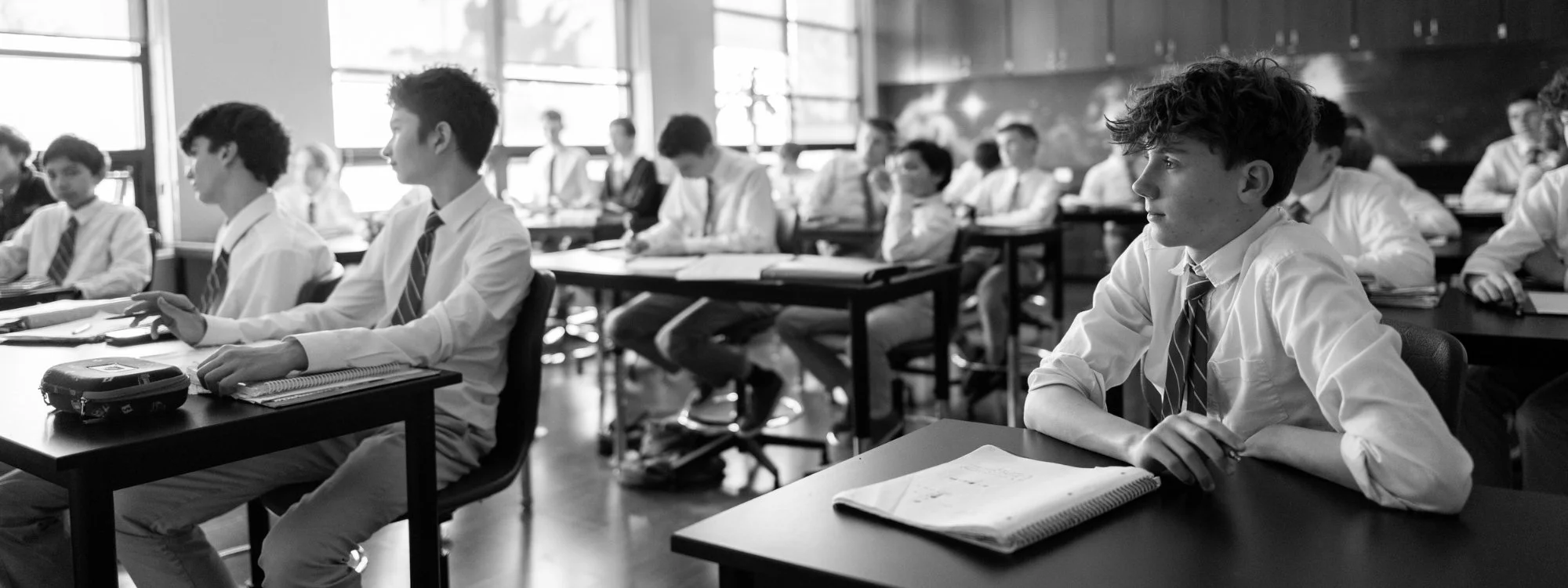
We believe in balancing formal instruction (lecture) with student participation.
While Progressive education fails by prioritizing active learning over traditional curriculum, we believe many traditional schools disregard active learning to their detriment. We teach our teachers how to have an active and engaged classroom founded in a traditional liberal arts framework. Our approach balances engagement with order, freedom with rigor, tradition with creativity.

Is Teaching Foundations Classical?
Although we don’t use the label “Classical,” we root our approach in the anthropology of the traditional Liberal Arts. Our own insights are drawn from thinkers like Plato, Aristotle, Aquinas, C.S. Lewis, and John Henry Newman. We also strongly advocate for - and include - active learning techniques and insights that dovetail with perennial wisdom. Many of these techniques are labeled - and sometimes disparaged - as “modern” but in fact have roots in Socrates.
A note about Co-Ed:
While Northridge is all-boys, our offerings assume a co-ed school environment.
Four Principles of the Classroom
The following principles guide all the offerings of the Northridge Institute - in parentheses is its match to Aristotle’s four causes:

Teacher's Content Mastery
(Material Cause)
The mind is not a bucket to be filled, but a fire to be kindled. -Plutarch
Every classroom needs a guide. After all, you cannot give what you do not have. Real learning requires teachers to possess a deep knowledge of their subject. Such teachers share their expertise, their experience, but more than that, their love of the subject with their students. The human naturally desires what is good, according to Aquinas. Teachers do not merely give knowledge like filling a bucket. At their best, they kindle a student’s affection and turn their will toward something good.

Active Learning
(Formal Cause)
Learning consists, not merely in the passive reception into the mind of a number of ideas hitherto unknown to it, but in the mind’s energetic and simultaneous action upon and towards and among those new ideas. -John Henry Newman
All education is some form of self-education because learning is never a passive activity. That is why we teachers must always keep in mind what we want our students to do in a lesson, not only what we plan for them to know at the end of it. Aristotle noted that “men become builders by building.” Just so, our students become liberally educated–men and women who can think freely–by practicing the work of thinking. Active learning is what gives form to our content.

Friendship-Among-Unequals
(Efficient Cause)
There is another kind of friendship, namely, that between unequal parties. -Aristotle
Although students and teachers should never be “equals” in the classroom, students cannot learn from those they do not respect. A kind of friendship should exist between students and teachers stemming from good will, but with the two parties owing each other different things. From the student, respect and effort; from the teacher, care and encouragement. The relationship between the teacher and the student acts as the efficient cause of classroom learning.

A Spirit of Adventure
(Final Cause*)
An adventure is only an inconvenience rightly considered. An inconvenience is only an adventure wrongly considered. -G.K. Chesterton
Adventure is not just for overnights or trips. Each challenge, even failure, is a chance to grow rather than a reason to retreat. A spirit of optimism, adventure, and a growth mindset offers students the opportunity to learn from mistakes, both in the classroom and in life. This is the goal of our education: to equip students with the virtue to face the challenges of life and the problems of the world with a gritty optimism. The rubric for success is not “did my students pass the test in my classroom,” but rather “are they facing the challenges of life with a spirit of adventure ten years after they graduate?”
* This is not technically true: the Final Cause of education is MORE than a spirit of adventure. However: any great person only becomes so with a spirit of adventure. It implies a growth mindset, hope and faith in the future (ie, in God): the importance of the spirit of adventure is under-appreciated. It is extremely powerful.
Principles of School Culture
An Education in Freedom
Our Christian faith tells us to ensure that everyone enjoys a climate of freedom. -Josemaria Escriva
We are all attracted to what we think is good. Josemaria Escriva writes, quoting Thomas Aquinas: Nobody else can choose for us: 'men's supreme dignity lies in this, that they are directed towards the good by themselves, and not by others'. That attraction cannot be forced: it must be chosen freely. That is why freedom is not merely an opportunity for fun or enjoyment, but a key aspect of a liberal education. After all, such an education is for the liberi: for a free people. Educators offer a vision of goodness–in character, in learning, in friendship–to students, who must be able to choose it for themselves. Without small opportunities to practice freedom in childhood, they will not know how to use freedom later in life. Small freedoms given with guidance are the training ground for free citizens.
Accompaniment
By being loved in the things they like, through taking part in their youthful interests, they are led to see love in those things too which they find less attractive. -John Bosco
The teacher’s vocation is both demanding and fulfilling because the teacher is always forming students by her presence. Sports, music, drama, and other co-curricular activities are not add-ons to student formation, but important vehicles for it. But so too are lunch-time conversations, recess games, friendly conversations in the hallway, and simple acts of kindness. It is often the quiet one-on-one conversations which show interest in the students’ lives rather than the classroom lectures that leave the deepest impact. Being with students is just as much a part of teaching as being in front of students.